

On this page
- What Responsible Gambling Means on WinMatch
- Responsible Gaming | Winmatch
- Preventing Problem Gambling
- Set a Gambling Budget Before You Deposit
- Keep Track of the Whole Session, Not One Bet
- Do Not Chase Losses
- Responsible IPL and Sports Betting
- Sports Knowledge Does Not Remove Gambling Risk
- Be Extra Careful with Fast Casino Games
- Set a Time Limit as Well as a Money Limit
- Tools for Responsible Gaming
- Responsible Gambling on the WinMatch Mobile App
- Avoid Gambling When Angry, Stressed or Intoxicated
- Bonuses Should Not Decide Your Spending
- Understand Bonus Money Before Playing
- Deposits Should Have a Purpose
- Withdraw Winnings Instead of Automatically Recycling Them
- Recognising When Gambling Is Becoming a Problem
- Player Protection Measures
- Account History Can Be Useful
- KYC and Account Security Are Different from Responsible Gambling
- Age Restrictions in Winmatch
- Parental Controls
- Do Not Borrow Money to Gamble
- Take Breaks from Gambling
- Using WinMatch Support
- Support for Problem Gamblers
- A Simple Responsible Gambling Routine
- Responsible Gambling Across WinMatch
- How to read a week with a pending withdrawal
- Preparing for a break on a shared phone
- Reviewing the difference between money, time and attention
- What to keep after requesting self-exclusion
What Responsible Gambling Means on WinMatch
Start with the effect that gambling has outside the account. Is money still available for travel, food, bills and repayments? Is time spent on the phone disrupting sleep or work? A green balance or a successful identity check cannot answer either question. A person can be ahead for the day and still feel unable to stop.
The original product brought a sportsbook, exchange and casino under one login. This matters for self-assessment because each part of the interface can give the impression of starting a new activity. Changing the tab does not change the amount already committed, the time that has passed or an outstanding liability on an exchange position.
Responsible Gaming | Winmatch

The former protection guide described age checks, account restrictions, reminders and parental controls. Each addresses a different point at which someone can reduce unwanted access.
Preventing Problem Gambling

Intervene when gambling starts displacing ordinary routines. A person may notice repeated checking at work or difficulty sleeping before the bank balance looks alarming. Bringing the pattern into the open early can make it easier to change the conditions that sustain it.
Set a Gambling Budget Before You Deposit
| An action that limits spending | A pattern that increases exposure |
|---|---|
| Choose an entertainment allowance before deciding whether to deposit. | Wait until the cashier is open to decide what feels affordable. |
| Set aside only money that can be lost without affecting commitments. | Use funds earmarked for essentials or upcoming bills. |
| Keep each stake within the limit set at the outset. | Raise the spending limit in response to a loss. |
| Read the running balance alongside the record of bets. | Estimate the session’s outcome from memory alone. |
| Finish the session once the allowance is exhausted. | Immediately add more funds in an attempt to recover the shortfall. |
A historical cashier limit describes what a payment channel was configured to process. It says nothing about what an individual could afford to lose. The former mobile table started at ₹100 and listed a ceiling of ₹50,000. Neither figure is a personal spending recommendation. If the household has no discretionary money left, the relevant limit is zero.
Write down essential expenses, debts due and savings commitments before calculating disposable funds. Do not assume a pending withdrawal will arrive in time to cover a bill. A budget loses its protective value if it is routinely increased after a loss.
| Measure | Worked example | What it means |
|---|---|---|
| Total settled stakes | Five entries of ₹200 = ₹1,000 | Counts the full amount put at risk, including replayed funds. |
| Gross credits | Settled returns add to ₹760 | Includes any returned portion of stakes. |
| Net outcome | ₹760 − ₹1,000 = −₹240 | Measures the change caused by these settled entries. |
| Cash movement | A separate ₹500 transfer appears in the statement | Moving money into an account is not a win. Keep it out of the game-result sum. |
Reconcile a session
Use settled cash only. This illustration assumes there are no open bets, bonuses, fees or adjustments.
Keep Track of the Whole Session, Not One Bet
The easiest figure to remember is often the most recent result. A large win may stand out even when a series of earlier losses costs more. Reconstruct the period using the opening cash balance, external deposits, external withdrawals and closing cash balance. Keep promotional credit and open bets separate so they do not distort the comparison.
Consider an account that opens with ₹1,000, receives a ₹500 deposit, pays out ₹200 to a bank and closes with ₹900 in cash. With no open positions or adjustments, the session result is ₹900 + ₹200 − ₹1,000 − ₹500, or a loss of ₹400. The ₹200 bank credit on its own would have told a very different story.
Do Not Chase Losses
A useful question after a loss is whether the next decision would still make sense if the balance screen were hidden. A wish to restore the exact figure that was there an hour ago gives the previous result control over the next stake. An extra payment made for that reason deserves attention even if it is small.
Doubling from ₹500 to ₹1,000 after a loss increases the money at risk. It does not give the next roulette spin or cricket outcome a better chance of going your way. Closing the session interrupts the sequence immediately. Trying to finish with a particular balance allows a random event to decide when you leave.
Responsible IPL and Sports Betting
A wicket, an injury or a pause for rain can shift the displayed price. A rapid change is easy to experience as an instruction to act. It is simply new information in the market. A viewer can follow the broadcast and let the market pass without adding another financial decision.
An innings market, a player market and a match-winner selection can all depend on the same passage of play. Several small positions on one fixture may therefore create substantial combined exposure. Reviewing them together gives a clearer picture than counting how many separate selections appear on a slip.
Sports Knowledge Does Not Remove Gambling Risk
Knowing a team's selection policy can help explain a market. It cannot settle an unfinished match. A strong batter can be run out without facing a full over, and a weather interruption can change both the match and the settlement rule. Expertise does not eliminate this uncertainty.
Keep two questions separate when reviewing an old loss. Was the analysis reasonable with the information available at the time? Did the activity fit a limit you could sustain? An informed guess can still lose, and an accurate prediction does not justify money needed for essentials.
Be Extra Careful with Fast Casino Games
The time between decisions is a material difference between formats. A match bet may remain open for hours. A slot or crash game can produce many decisions in that time, and a live table has its own recurring betting window. Small individual stakes can add up before a player notices the duration of the session.
Forty rounds at ₹50 create ₹2,000 in turnover. Turnover is the total staked, not necessarily the net loss. To find the loss, compare stakes with payouts and account movements. Seeing both numbers is helpful: turnover reveals the pace of repeated decisions while net loss shows their financial effect.
Set a Time Limit as Well as a Money Limit
A money limit cannot recover an evening spent looking at odds. Choose a stopping time that protects the next obligation, whether that is a meal, a shift or sleep. An alarm outside the gambling application remains visible even if the interface changes.
A time boundary is meaningful on a winning day too. If an alarm becomes a cue to wait for the next result, stop opening new rounds before the boundary. An existing unsettled selection does not require a phone screen to stay on until the result arrives.
Tools for Responsible Gaming
A deposit limit restricts incoming funds; a session reminder draws attention to time; self-exclusion restricts access for a defined period. Select the control that matches the difficulty. A reminder which can be dismissed may be insufficient for someone who feels unable to stop.
Responsible Gambling on the WinMatch Mobile App
Mobile access removes many pauses that once separated a person from a gambling session. A sports notification on a commute can reopen the lobby before the initial decision even feels deliberate. Turn off promotional notifications and remove shortcuts from the home screen if they lead to repeated checking.
Deleting an app can create distance, but an account and recurring messages may still exist. If the intention is a longer break, also review stored passwords, marketing permissions and the operator's account-restriction options. Keep a copy of any confirmation outside the app.
Avoid Gambling When Angry, Stressed or Intoxicated
Notice when the purpose of opening a game changes. Trying to escape an argument, make up for a bad day or numb anxiety is different from choosing entertainment. Alcohol, fatigue and anger can also make a previously agreed stopping point easier to disregard.
Close the activity before deciding what to do about the money. Put the device down, move to another room and speak to someone you trust if the pressure persists. A missed live market has no effect on your household finances; an impulsive payment can.
Bonuses Should Not Decide Your Spending
A reward that appears only after a larger payment can move the focus from the cost to the advertised benefit. If a person has ₹500 available for discretionary spending and an offer calls for ₹1,000, the arithmetic still starts with the additional ₹500 leaving the household. The headline percentage does not cancel that outlay.
The same issue arises with a time-limited code, a birthday reward or an invitation to refer someone. Expiry creates a deadline for the promotion; it does not create an obligation for the reader. An unclaimed incentive cannot turn into a cash loss on a bank statement.
Understand Bonus Money Before Playing
A promotional balance can be displayed beside withdrawable cash. The two figures may be governed by different rules. Identify the calculation base, eligible games, contribution percentage, expiry and the effect of a withdrawal before interpreting an archived bonus transaction.
As an example, a ₹200 promotional balance subject to a ten-times bonus-only condition implies ₹2,000 of qualifying turnover. It does not imply a ₹2,000 payout or that the reader must complete the condition. Continuing to chase turnover can cost more than the displayed credit.
Deposits Should Have a Purpose
In a payment history, clusters of top-ups often say more than the size of the first payment. Five ₹200 debits have the same immediate impact on the bank balance as one ₹1,000 debit. The individual confirmation screens can make the repeated choice harder to notice.
When reviewing old records, group transfers by session or calendar day as well as by method. Switching from one payment app to another can split the entries across two transaction lists. Avoid counting an underlying UPI transfer twice when both the app and bank show the same reference.
Withdraw Winnings Instead of Automatically Recycling Them
Once a win forms part of eligible cash, spending it again risks money that otherwise had value outside the account. Labelling it “profit” does not change what the household could do with it. Separate settled cash from promotional balances and pending transactions before working out what was actually available.
A request marked pending is not a bank credit. Keep the reference and check the receiving statement. If someone demands a fresh deposit to release funds, stop and verify the demand with your bank through its known contact channel.
Recognising When Gambling Is Becoming a Problem
| A pattern consistent with staying in control | A possible warning sign |
|---|---|
| Participation remains an optional leisure choice. | The person feels compelled to take part. |
| Losses stay within a limit decided in advance. | A loss prompts the person to increase their next deposit. |
| A break can be taken when planned. | Stopping or stepping away becomes difficult. |
| The amount spent can be discussed openly. | Spending is concealed from people affected by it. |
| Only disposable funds are involved. | Household essentials or borrowed funds are put at risk. |
| A lost stake is treated as a completed outcome. | The next wager is placed specifically to win back a loss. |
Look for patterns over a period rather than trying to diagnose a single evening. Hiding transactions, borrowing, repeatedly moving a stopping point, missing obligations or becoming distressed when unable to check a market are reasons to seek support. A lack of large individual losses does not make those patterns harmless.
A trusted person can help compare remembered spending with actual bank debits. If speaking feels difficult, begin with one concrete fact such as “I have topped up three times this week after deciding to stop.” It gives the conversation a practical starting point.
Player Protection Measures
Earlier WinMatch material described limits and self-exclusion. For an existing account, request written confirmation of the specific control, covered products, duration and effective time. An acknowledgement that support received a message is different from confirmation that a restriction has taken effect.
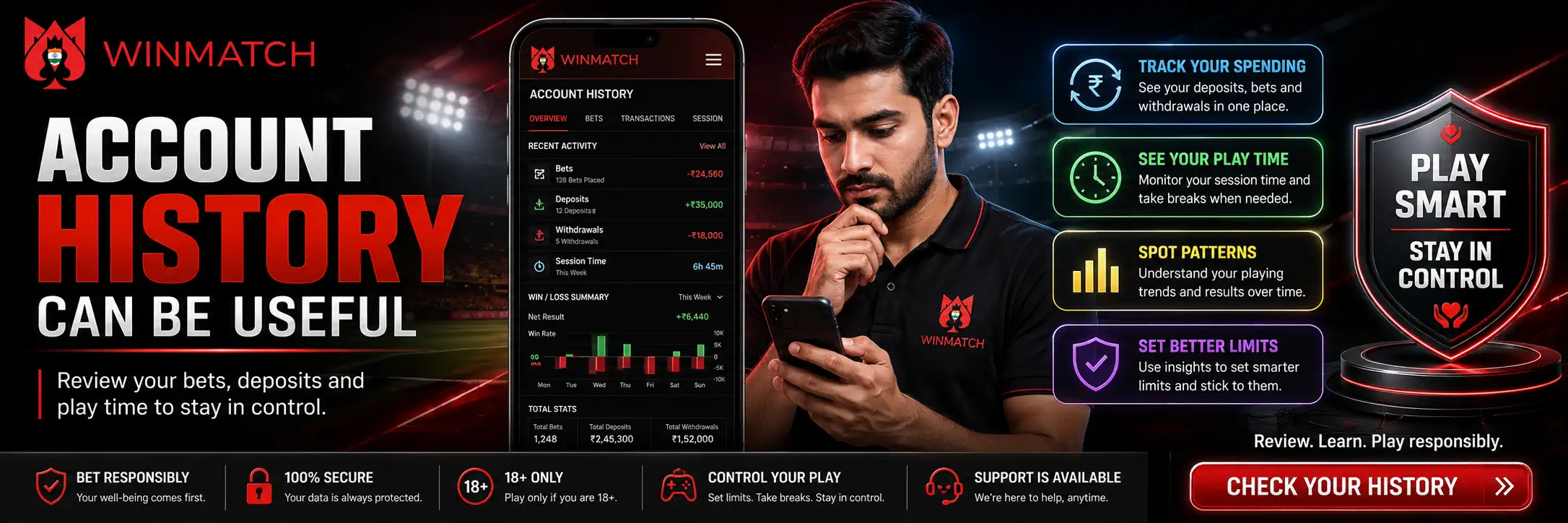
Account History Can Be Useful
Save the date, reference, amount, direction and status of each relevant transaction. Reconcile deposits against bank debits and withdrawals against bank credits. A rejected withdrawal, a void selection and a bonus adjustment can all change the apparent story if read as settled cash.
Use a consistent period. Comparing a seven-day loss with a single winning Saturday produces a misleading impression. When an exchange order or a sports bet remains open at the end of the period, identify it separately before drawing conclusions about the final result.
KYC and Account Security Are Different from Responsible Gambling
An identity check may establish that a document belongs to the person named on the account. It does not establish that the account holder can afford the transactions. Encryption likewise protects communication, not the person's time or spending choices.
If a concern involves unauthorised access as well as distress about spending, address both. Contact the bank about unrecognised debits and the account provider about access. Ask for independent support with gambling harm if the activity has become hard to control.
Age Restrictions in Winmatch
The former account rules set a minimum age of 18 and referred to identity checks. On a shared device, a remembered adult login can bypass the normal opportunity to check who is using it. Sign out and protect saved payment details. Meeting an age threshold does not override local restrictions.
Parental Controls
Separate device profiles, family purchase approvals and content restrictions can reduce accidental exposure. The older guide mentioned products such as Net Nanny and GamBlock. Check the coverage of any tool on the actual phone and browser, especially after an operating-system update. Technical restrictions work best alongside clear household rules about passwords and payments.
Do Not Borrow Money to Gamble
Borrowing creates a repayment obligation whether a selection wins, loses or is void. An overdraft, an advance from a friend and money set aside for rent are all forms of exposure outside the gambling account. A visible balance on a phone can hide who ultimately needs that money back.
If debts already exist, write down the lender, amount and due date. A further bet is not a repayment plan. A trusted adult or independent debt adviser can help prioritise essentials without relying on an uncertain result.
Take Breaks from Gambling
A break can begin before there is a financial emergency. Make the intention concrete by choosing a start time, closing sessions and removing prompts that repeatedly draw you back. Keep the account-restriction request and the reply, including the effective date.
For a formal restriction, ask whether it covers the sportsbook, casino, mobile access and promotional messages. A marketing unsubscribe, a temporary time-out and account closure can have different effects. Check what happens to an outstanding balance and an open support ticket.
Using WinMatch Support
Operator support can explain account settings, answer a restriction request and identify a transaction. It is not a substitute for counselling, peer support or medical help. These services have different roles and it is reasonable to use more than one.
For a restriction request, be precise about the requested action, duration and contact preferences. For independent support, Gambling Therapy offers online information and support; Gamblers Anonymous provides peer-support meetings. Use the organisations' own directories to identify a service that suits your language and location.
Support for Problem Gamblers
Someone affected by another person's gambling can seek help too. A family member may need advice about joint finances, childcare or how to start a conversation. A support worker or peer group can help with those questions even when they cannot inspect an operator account.
A Simple Responsible Gambling Routine
For an existing account, review three records together: bank movements, activity history and time spent on the device. If one is missing, mark the gap rather than treating it as zero. A deposit total excludes recycled funds; a turnover total includes them. Neither replaces a review of the whole period.
Then agree one immediate action that can be checked, such as disabling promotional messages, taking a break or asking a trusted person to help review bank records. Revisit that decision on a fixed date outside a live sporting event.
Responsible Gambling Across WinMatch
The interface separates games because they work differently. Household finances do not. Combine sports, casino, exchange and promotional activity before deciding what a period has cost. Include both Android and browser sessions if the same account was accessed on different devices.
How to read a week with a pending withdrawal
Suppose a statement opens Monday with ₹2,400 in settled cash and records two bank deposits, ₹300 on Tuesday and ₹500 on Thursday. The dashboard later deducts ₹700 when a withdrawal request is submitted, but the receiving statement shows no matching credit by Sunday. Treat the ₹700 as a pending transfer between the two records. Calling it both a household receipt and part of the remaining account balance would count it twice.
Check the status again using the original reference. If the withdrawal was cancelled and the ₹700 returned to the account, it was never a completed bank withdrawal. If the bank later credited it, record that receipt once and retain the date. This distinction matters to a household trying to decide whether money is available for a bill. The only amount it can actually spend from the bank is the amount credited there.
For a clean weekly comparison, define the start and end times in the same time zone. Exclude promotional credits that cannot be withdrawn, identify unsettled bets separately and note any adjustment that lacks a description. If you cannot reconcile a period because of an open transaction, leave that entry pending and investigate it; recording it as a zero creates false certainty.
Reviewing the difference between money, time and attention
A device can report three hours of screen time even when only a few minutes were spent placing selections. An account list might show ten completed rounds over those three hours. The bank might show a single debit. Each record answers a different question. Use screen time to understand disruption, game history to understand decisions and the bank statement to see the effect on household funds.
For example, repeated odds checks during a shift might create problems at work even if there was no new deposit. The meaningful action could be disabling alerts and leaving the phone outside a particular workspace. In another case, a single large debit may be the issue despite a short session; that calls for a review of bank access and essential spending. Counting bets alone would miss both patterns.
If you are reviewing these records with someone else, agree first on what they want help with. Reviewing one week of bank debits with their permission can be more useful than asking for the password to every account. Agree a date to review progress and choose a setting away from a live fixture or a payment reminder.
What to keep after requesting self-exclusion
An account-restriction request can reach support while a sports ticket is still unsettled or a bank withdrawal is in progress. Before closing the conversation, ask how those existing items will be handled and how you can obtain an account statement while the restriction is active. Save the answer with the ticket number and the date the restriction takes effect. You should be able to follow a payment query without reopening access to games.
Take an example. A person requests a six-month exclusion on Friday and already has a ₹1,500 bank withdrawal marked sent. The exclusion acknowledgement and the bank transfer confirmation answer separate questions. Keep the first to establish when access should stop. Keep the second, including its bank reference, to trace the payment with the receiving institution. A marketing message that arrives on Saturday should be reported against the restriction ticket. Opening a new profile to investigate the withdrawal would make that separation harder.
If you are helping a relative, agree on which records they want you to keep and how to contact them for a follow-up. A copy of the restriction confirmation is usually sufficient for that conversation. Their account password or payment PIN is not needed.
Current rules in India
India prohibits online money games and their promotion. The product screens and account terms shown here document earlier versions of WinMatch. Government of India · Online Gaming Rules, 2026
Independent support · Gambling Therapy · Gamblers Anonymous
Published · Updated